
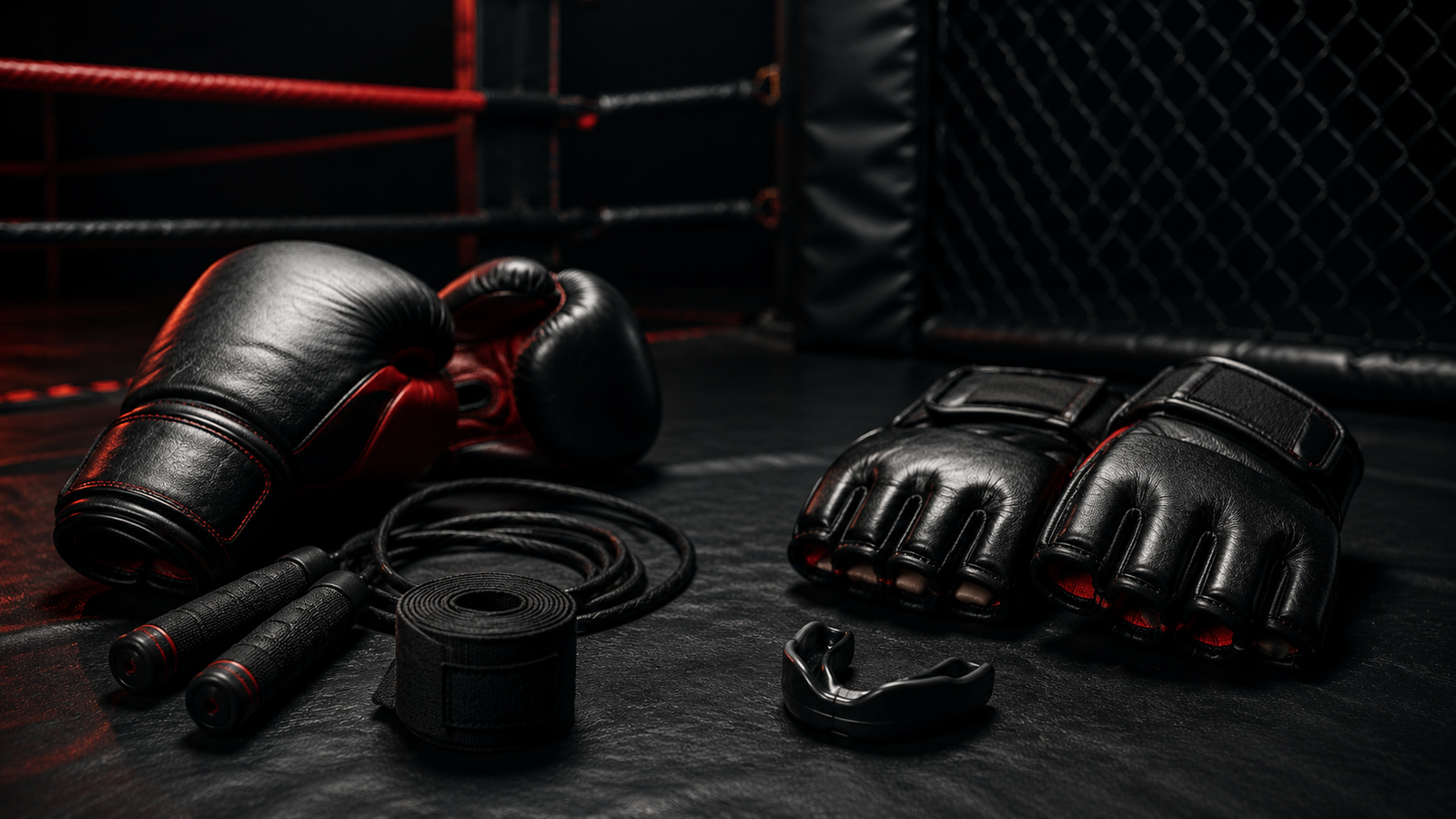
Boxing and MMA share punches, footwork, defense and ring craft, but they are structurally different sports. Boxing is built around punching within a boxing ruleset. MMA allows striking alongside takedowns, clinch wrestling and ground grappling. That changes the meaning of stance, distance and even familiar punches.
The point of a useful comparison is not to decide which sport is “better.” It is to understand what each athlete is solving under the rules.
Legal offense
In boxing, offensive scoring is built around legal punches. Kicks, knees, elbows, takedowns and submissions are outside the sport.
MMA permits a much wider family of attacks, subject to the applicable rules: punches, legal kicks and knees, takedowns, positional grappling, submissions and defined ground striking.
Because the threat set is wider, an MMA athlete must think about more than the next punch exchange.
Gloves
Boxing gloves enclose the hand in a larger padded structure built around punching. MMA competition gloves use an open-finger design so athletes can grip and grapple.
That changes hand fighting and defensive habits. A high closed boxing guard uses glove size differently from an MMA guard, where smaller gloves can pass through gaps and hands may also be used to frame, pummel or fight grips.
Stance and movement
Pure boxing allows athletes to optimize stance around punches and boxing footwork. MMA stance choices must also account for kicks and takedowns.
A very bladed stance can reduce a visible target for punches but may change leg-kick exposure or takedown reactions. A heavy front leg can support boxing offense while creating different risks against kicks. These are tradeoffs rather than universal rules.
Many successful MMA athletes use high-level boxing mechanics, but they adapt them to the larger threat environment.
The clinch
Boxing has clinch situations, but the referee separates athletes according to boxing rules. The clinch is not an extended wrestling phase.
In MMA, clinching can become an offensive system: short strikes, underhooks, body locks, trips, takedowns, fence control and back takes can all develop from close range.
This is one of the clearest reasons boxing cannot simply be pasted into MMA unchanged.
What happens after a knockdown?
In boxing, a knockdown can trigger a count and the boxer has a defined opportunity to recover if able under the rules.
In MMA, the opponent can often follow the hurt athlete to the ground and continue with legal offense until a finish, submission, recovery or referee stoppage. There is no standard boxing-style standing eight/count sequence after every knockdown.
That makes balance after punching especially important.
Round structure and scoring
Boxing and MMA both use round-based judging systems, but the round duration, number of rounds and scoring criteria differ by competition.
MMA under the Unified Rules uses the 10-Point Must System with effective striking and grappling as the primary criteria. Boxing judging evaluates boxing-specific criteria under the relevant federation or commission rules.
A fan should never use “he landed a takedown” as a boxing concept or count every MMA punch as though the fight were a boxing match.
Why boxing is still fundamental to MMA
Boxing contributes some of MMA’s most important tools:
- efficient straight punches;
- hooks and uppercuts;
- combination construction;
- head movement and defensive awareness;
- footwork for creating punching angles;
- timing and counterpunching.
The adaptation is what matters. An MMA boxer learns when punching posture creates wrestling risk, how kicks change entries, and how to strike when the opponent can clinch or shoot.
Which sport should a beginner choose?
If you want deep specialization in punching, boxing offers a focused technical environment. If you want to connect striking to takedowns and submissions, MMA is the more direct ruleset.
A strong boxing gym and a strong MMA gym can both produce excellent athletes. Coaching quality, safety culture and consistency are more useful beginner criteria than internet debates.
The takeaway
Boxing and MMA overlap, but the rulebook changes the geometry of the fight. Boxing narrows the weapon set and allows extraordinary specialization. MMA broadens the threat set and rewards integration. That is why great MMA boxing often looks like boxing — but never exactly like boxing alone.
From TATSU
MMA-inspired tees and hoodies built around the culture this article covers — no generic designs, no noise.
Sources and further reading
- World Boxing — Competition Rules — Current official World Boxing competition rules access.
- Association of Boxing Commissions — Unified Rules — Current professional MMA and boxing rules hub.
- UFC — Unified Rules of MMA — Accessible overview of the MMA Unified Rules framework.
Related reading
Continue exploring: What Is MMA? · MMA Gloves vs Boxing Gloves · Heavy Bag vs Focus Mitts vs Thai Pads · What Is Martial Arts Streetwear? · After Rounds T Shirt Design Story